Digital marketing has always changed alongside the way people search for information. From traditional keyword searches to mobile search, voice assistants, and now AI-powered platforms, businesses have continuously had to adapt their strategies to stay visible.
One of the latest developments in this evolution is Answer Engine Optimization (AEO).
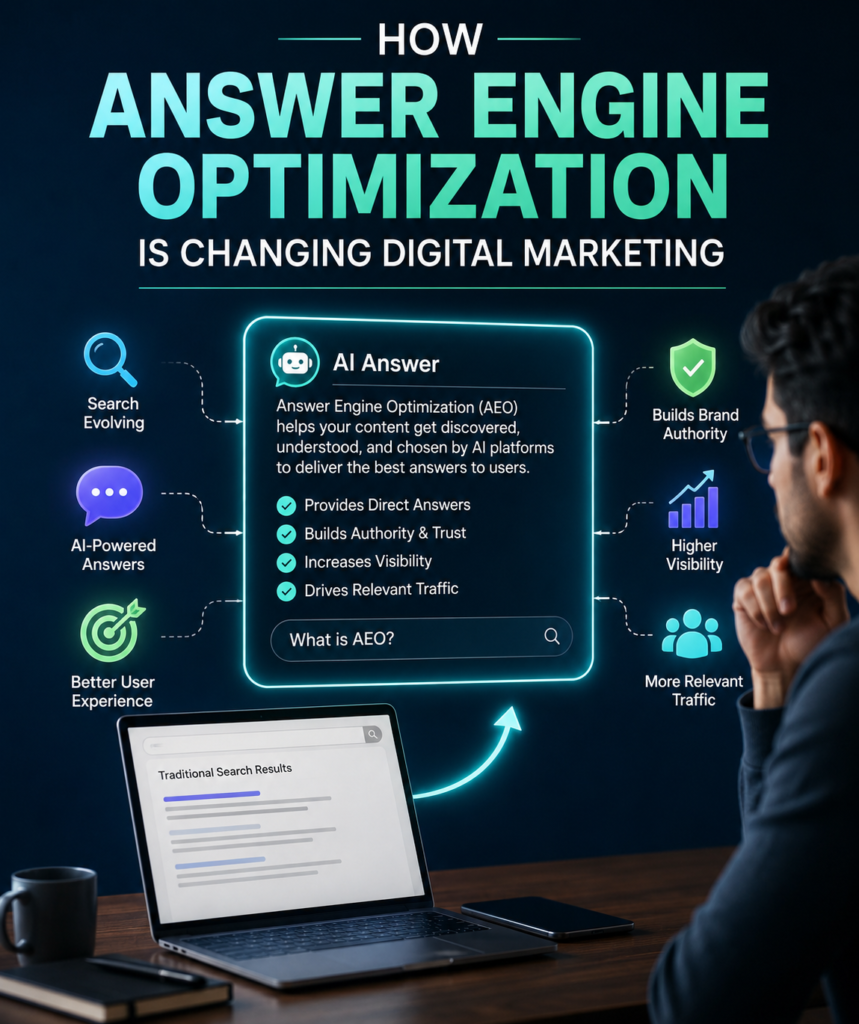
Traditional SEO primarily focuses on helping webpages appear prominently in search engine results. AEO takes a slightly different approach. Instead of concentrating only on rankings, it focuses on creating content that clearly answers the questions users are asking.
This change is becoming increasingly important as search experiences become more conversational. People are asking complete questions, expecting direct answers, and using AI-powered tools to find information faster.
For digital marketers, this means the goal is no longer simply to attract clicks. Businesses also need to provide information that is useful, understandable, trustworthy, and easy for search and answer systems to interpret.
What Is Answer Engine Optimization?
Answer Engine Optimization, or AEO, is the process of optimizing digital content so that it can effectively answer users’ questions in search and answer-driven experiences.
Traditional search often works like this: a user enters a keyword, a search engine displays results, and the user visits a website to find the answer.
AEO focuses more directly on the question-and-answer relationship.
For example, instead of searching:
“digital marketing benefits”
a user might ask:
“How can digital marketing help a small business get more customers?”
The second query reveals much more about the user’s intent.
An AEO-focused content strategy attempts to answer that question clearly and comprehensively.
This does not mean that SEO is becoming irrelevant. Instead, AEO can be viewed as an extension of good SEO practices, with greater emphasis on search intent, conversational queries, structured information, and direct answers.
Why Is AEO Becoming Important?
Search behaviour is changing.
People are becoming more comfortable asking questions in natural language rather than entering short combinations of keywords.
Voice search contributed to this shift, while conversational AI has accelerated it.
Instead of searching:
“best digital marketing agency Kochi”
someone may ask:
“What should I look for when choosing a digital marketing agency for my business?”
This creates a new challenge for marketers.
They need to understand not only what people search for, but also why they search for it and what answer they expect.
AEO addresses this challenge by encouraging businesses to create content around real questions and useful answers.
AEO vs Traditional SEO
SEO and AEO have a strong connection, but their focus can be different.
Traditional SEO often emphasizes:
- Keyword research
- Website optimization
- Technical SEO
- Backlinks
- Search rankings
- Organic traffic
- Search intent
AEO adds greater emphasis on:
- Questions
- Direct answers
- Conversational language
- Featured-answer opportunities
- FAQs
- Structured content
- User intent
- Clear explanations
For example, an SEO strategy may target the keyword “what is content marketing.”
An AEO strategy would consider questions such as:
“What is content marketing?”
“How does content marketing work?”
“Why is content marketing important for businesses?”
“What are examples of content marketing?”
Instead of creating one page focused on a single keyword, marketers can build a resource that answers several closely related questions.
The Shift From Keywords to Questions
One of the biggest ways AEO is changing digital marketing is the shift from keyword-focused thinking to question-focused thinking.
Keywords are still useful, but they don’t always reveal the complete intent behind a search.
Consider the keyword:
“Google Ads.”
It could mean that the person wants to:
- Learn what Google Ads is
- Start a Google Ads campaign
- Find an agency
- Understand pricing
- Learn about campaign optimization
- Compare Google Ads with other advertising platforms
A question provides more context.
For example:
“How much should a small business spend on Google Ads?”
Now the marketer has a clearer understanding of the user’s intent.
This makes question-based content valuable for businesses trying to connect with potential customers at different stages of the buying journey.
How AEO Is Changing Content Marketing
Content marketing is one of the areas most affected by AEO.
In the past, some businesses created articles primarily to target high-volume keywords. The result was sometimes content that technically contained the right keywords but did not provide a satisfying answer.
AEO encourages a different approach.
The first priority becomes usefulness.
A good AEO-focused article should answer the main question quickly and then provide supporting information.
For example, an article titled “What Is SEO?” should not spend several paragraphs discussing unrelated topics before defining SEO.
A reader should be able to understand the basic answer almost immediately.
After that, the article can explain:
- How SEO works
- Why SEO matters
- Different types of SEO
- Common SEO mistakes
- SEO best practices
- Examples
- Frequently asked questions
This structure benefits users while also making the information easier to understand and navigate.
The Importance of Search Intent
Search intent has always been important in SEO, but AEO makes it even more significant.
There are generally four common types of search intent:
Informational Intent
The user wants to learn something.
Example:
“What is AEO?”
Navigational Intent
The user wants to find a particular website or brand.
Example:
“Google Ads login.”
Commercial Investigation
The user is researching before making a decision.
Example:
“Best SEO services for small businesses.”
Transactional Intent
The user is ready to take action.
Example:
“Hire an SEO consultant.”
AEO-focused content should be created according to the intent behind the query.
A person asking for a definition does not need a sales-heavy landing page. Someone looking for a service may need pricing information, benefits, comparisons, and a clear call to action.
FAQs Are Becoming More Valuable
Frequently Asked Questions can play an important role in an AEO strategy.
A well-designed FAQ section can address common questions that customers have before purchasing a product or service.
For a digital marketing business, an FAQ section might include:
What is digital marketing?
How long does SEO take to show results?
How much does social media marketing cost?
Is Google Ads suitable for small businesses?
What is the difference between SEO and AEO?
These questions can also help marketers discover new content ideas.
However, FAQs should not be created simply to add keywords. They should answer genuine questions with useful information.
Conversational Content Is Becoming More Important
AEO is also influencing the writing style used by digital marketers.
People don’t always search the same way they write traditional keywords.
Conversational queries can be longer and more specific.
For example:
“How can I improve my website ranking?”
or
“What are the best ways to get more leads from my website?”
Content should therefore use natural language.
This doesn’t mean writing every article like a conversation between two people. It means avoiding unnatural keyword repetition and explaining concepts in a way that matches how real users think and ask questions.
The Role of Structured Content
The organization of content is important for AEO.
Search and answer systems need to understand what different sections of a webpage are about.
Clear headings can help organize information.
For example:
What Is AEO?
Why Is AEO Important?
How Does AEO Work?
How Can Businesses Implement AEO?
What Are Common AEO Mistakes?
Frequently Asked Questions
This structure helps readers quickly navigate an article and makes the relationships between topics clearer.
Businesses can also use appropriate structured data where relevant, but structured data should support genuine content rather than being treated as a shortcut to visibility.
AEO and Voice Search
Voice search has played an important role in the movement toward conversational search.
When people type, they may use short phrases.
When they speak, they often ask complete questions.
For example, a typed query might be:
“weather Kochi.”
A spoken query could be:
“What’s the weather like in Kochi today?”
The second query is naturally conversational.
Businesses can prepare for these types of searches by creating content that answers specific questions in clear language.
This is particularly useful for local businesses, service providers, and informational websites.
AEO and Local Businesses
AEO can also influence local digital marketing.
Imagine someone asking:
“Where can I find a good digital marketing consultant near me?”
A local business needs more than a keyword-optimized webpage.
It should have accurate business information, a clear description of its services, useful website content, customer reviews, and a consistent online presence.
Local SEO and AEO can therefore complement each other.
For service businesses, answering questions such as:
- What services do you provide?
- Which areas do you serve?
- How much do your services cost?
- Who are your services suitable for?
- How can customers contact you?
can make the business information more useful to potential customers.
AEO Is Changing the Role of Digital Marketers
Digital marketers are no longer simply keyword optimizers.
They increasingly need to understand:
- Customer questions
- Search behaviour
- Content strategy
- User experience
- Brand authority
- Data
- AI-powered search
- Conversion journeys
This makes digital marketing more strategic.
A marketer needs to ask:
What does my audience want to know?
What problems are they trying to solve?
What information will help them make a decision?
How can my brand provide a better answer than competing content?
These questions can lead to better content and stronger customer relationships.
AEO and AI-Powered Search
The rise of AI-powered search is another reason AEO has gained attention.
Modern search experiences can provide summarized answers instead of simply showing a traditional list of webpages.
This means users may interact with information differently.
Instead of visiting five websites and comparing information manually, they may receive a synthesized response and then choose whether to explore the sources behind it.
For marketers, this creates a new visibility challenge.
Being present in search may increasingly involve being a useful source of information rather than simply achieving a traditional ranking.
However, marketers should avoid assuming that any particular AEO tactic guarantees inclusion in AI-generated answers. These systems can change, and visibility can vary by platform and query.
How Businesses Can Start Using AEO
Businesses don’t need to completely rebuild their digital marketing strategy.
They can start with simple steps.
Step 1: Find Customer Questions
Talk to customers, analyze search queries, check website search data, review FAQs, and study questions asked on social media.
Step 2: Group Related Questions
Organize questions according to topics and search intent.
Step 3: Create Useful Content
Develop articles, service pages, FAQs, guides, videos, and other resources that provide clear answers.
Step 4: Improve Content Structure
Use descriptive headings, short paragraphs, lists, examples, and clear explanations.
Step 5: Strengthen Trust
Use accurate information and demonstrate real expertise through examples, experience, case studies, and reliable sources.
Step 6: Measure Results
Monitor organic traffic, search visibility, engagement, conversions, and relevant search features.
AEO should be treated as an ongoing process rather than a one-time optimization task.
Common AEO Mistakes
Businesses can make several mistakes when implementing AEO.
Keyword stuffing is one of them. Repeating a question or keyword excessively can make content unnatural.
Another mistake is writing extremely short answers without useful context. A direct answer is valuable, but complex topics often require explanation.
Businesses should also avoid creating content solely for search engines or AI systems. The primary audience should always be the human reader.
Finally, marketers should avoid making unrealistic promises. AEO can improve the structure and usefulness of content, but no ethical strategy can guarantee that an answer engine will always select a particular webpage or brand.
The Future of AEO in Digital Marketing
AEO is likely to become increasingly connected with SEO, content marketing, local search, voice search, and AI-powered discovery.
The future may not be about choosing between SEO and AEO.
Instead, successful businesses will combine them.
SEO can help a website become discoverable.
AEO can help its information become useful for question-based search.
Strong content can establish expertise.
Brand building can create recognition and trust.
Together, these elements can create a stronger digital presence.
The most important change is the mindset behind the strategy.
Marketers should stop thinking only about:
“Which keyword should I rank for?”
and start thinking about:
“Which questions does my audience need answered, and how can my business provide the most useful response?”
Answer Engine Optimization is changing digital marketing by shifting attention from keywords and rankings toward questions, answers, intent, and usefulness.
It does not mean that traditional SEO is disappearing. Instead, AEO adds another layer to search optimization.
Businesses that understand their customers, create genuinely useful content, structure information clearly, and demonstrate expertise will be better prepared for the evolving search environment.
The digital landscape will continue to change as AI-powered search becomes more common. The exact technologies and platforms may evolve, but one principle is unlikely to disappear:
People will always look for useful answers.
For digital marketers, the opportunity is to become the source that provides those answers.
In the future of search, visibility will not be only about being the first result. It will also be about being the most useful answer.