In today’s competitive digital market, businesses need a strong online presence to attract customers, generate leads, and increase sales. Two of the most powerful digital marketing strategies for achieving these goals are Google Ads and Search Engine Optimization (SEO). Both can help your business appear in Google search results, but they work in very different ways.
A common question business owners ask is: Google Ads vs SEO — which is better for my business?
The answer depends on your goals, budget, industry, competition, and how quickly you want to see results. Google Ads can put your business in front of potential customers almost immediately, while SEO focuses on building long-term organic visibility. In many cases, the best strategy is not choosing one over the other but using both strategically.
This guide explains the major differences between Google Ads and SEO, their advantages and disadvantages, costs, results, and how to decide which strategy is right for your business.
What Is Google Ads?
Google Ads is Google’s paid advertising platform that allows businesses to display advertisements across Google’s search engine and other Google properties.
When someone searches for a product or service related to your business, your advertisement may appear above or below the organic search results. You generally pay when someone clicks on your advertisement in a Search campaign.
For example, imagine someone searches:
“digital marketing agency in Kochi”
A business running a relevant Google Search campaign may appear in the sponsored section of the search results.
Google Ads can be used for several types of campaigns, including:
- Search campaigns
- Display campaigns
- Shopping campaigns
- Video campaigns
- Performance Max campaigns
- App campaigns
For businesses looking for immediate traffic, leads, sales, or visibility for specific offers, Google Ads can be a powerful marketing channel.
What Is SEO?
SEO, or Search Engine Optimization, is the process of improving a website so that it can appear more prominently in Google’s unpaid or organic search results.
Instead of paying Google for every click, businesses invest in improving their website, content, technical performance, authority, and relevance.
SEO typically includes:
- Keyword research
- On-page SEO
- Technical SEO
- Content creation
- Internal linking
- Link building
- Local SEO
- Website optimization
- User experience improvements
For example, if you create a useful and well-optimized page targeting “best digital marketing services in Kochi”, that page may eventually rank organically for relevant searches.
Unlike Google Ads, SEO does not require you to pay Google for each organic click. However, SEO requires time, expertise, consistent content, and ongoing optimization.
Google Ads vs SEO: The Key Difference
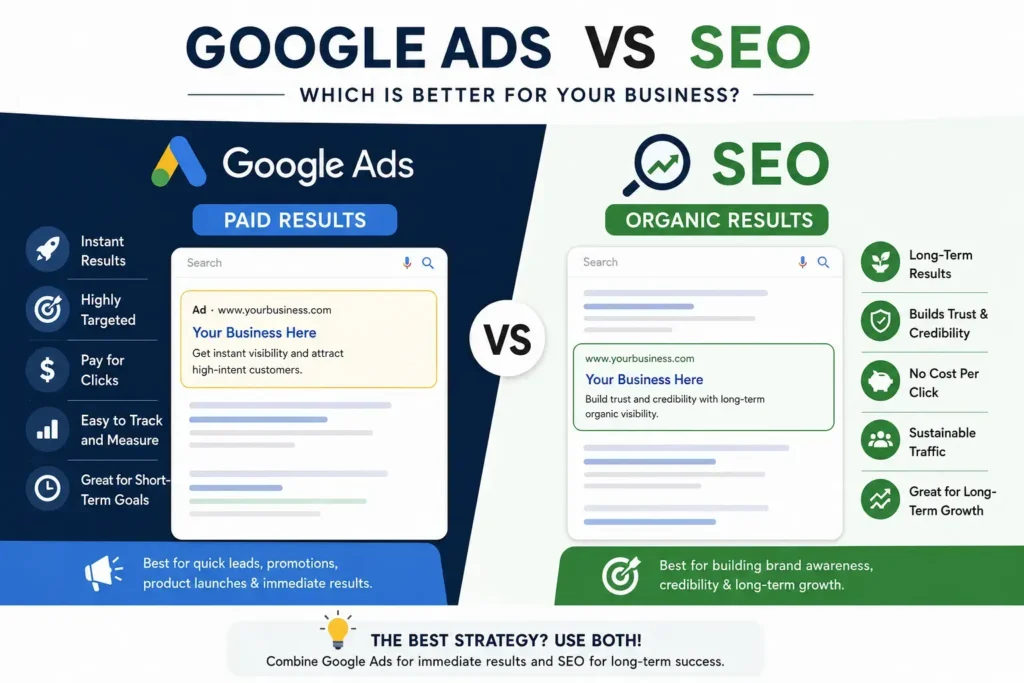
The biggest difference between Google Ads and SEO is paid visibility versus organic visibility.
With Google Ads, you pay to participate in an advertising auction and potentially receive immediate visibility for relevant searches.
With SEO, you work to earn higher organic rankings by demonstrating relevance, usefulness, authority, and a technically strong website.
A simple way to understand the difference is:
Google Ads = Pay for visibility
SEO = Build visibility
Both can bring highly relevant visitors to your website, but the process and timeline are different.
How Quickly Do They Produce Results?
One of the biggest advantages of Google Ads is speed.
Once your campaign is properly configured, approved, and launched, your ads can begin generating impressions and clicks relatively quickly. This makes Google Ads useful when a business needs immediate traffic or leads.
For example, a newly launched construction company could use Google Ads to promote services such as:
- Building construction
- Villa construction
- Commercial construction
- Renovation
- Interior work
SEO usually takes longer.
A new website may need months of consistent optimization and content development before achieving significant organic visibility. The timeline can vary considerably depending on competition, website authority, search demand, content quality, and technical factors.
Therefore:
Need faster traffic? → Google Ads
Building long-term visibility? → SEO
Google Ads vs SEO: Cost Comparison
Cost is another major difference.
Google Ads operates on an advertising budget. Your costs can depend on factors such as:
- Industry
- Keyword competition
- Location
- Audience
- Ad quality
- Bidding strategy
- Landing page experience
- Campaign structure
Highly competitive industries can have expensive clicks, while less competitive searches may cost less.
SEO works differently.
You may not pay Google directly for organic clicks, but SEO is not completely free. Businesses may invest in:
- SEO professionals
- Content writers
- SEO tools
- Website developers
- Technical optimization
- Content production
- Digital PR and link acquisition
Therefore, the idea that SEO is free is misleading.
SEO can reduce the cost of acquiring organic traffic over time, but achieving strong rankings requires investment and ongoing work.
Which One Has Better ROI?
There is no universal answer.
Google Ads can produce excellent ROI when campaigns are properly targeted and optimized. For example, if you spend money attracting visitors who are actively searching for your service and those visitors become customers, paid advertising can generate measurable returns.
SEO can also provide strong long-term ROI because organic traffic does not require a separate advertising payment for every click.
However, ROI depends on several factors:
ROI = Revenue generated ÷ Marketing investment
A poorly managed Google Ads campaign can waste money.
Similarly, poorly executed SEO can consume time and resources without generating meaningful traffic or conversions.
The real goal is not simply getting traffic. It is getting relevant traffic that produces business results.
Google Ads Gives You More Immediate Control
One major benefit of Google Ads is control.
You can decide:
- How much you want to spend
- Which locations to target
- Which keywords to target
- Which audiences to reach
- When ads should run
- Which landing page users visit
- Which offers to promote
You can also pause, modify, or scale campaigns based on performance.
This flexibility makes Google Ads particularly useful for promotions, product launches, seasonal campaigns, and businesses that need leads quickly.
SEO gives you less immediate control over rankings.
You can optimize your website and content, but you cannot simply pay Google to guarantee a particular organic ranking.
SEO Builds Long-Term Digital Assets
One of the strongest advantages of SEO is that your work can continue generating value over time.
Imagine you publish a comprehensive article targeting an important search topic. If that article eventually ranks well, it can continue attracting relevant visitors without you paying for every individual visit.
The same applies to:
- Service pages
- Product pages
- Blog articles
- Location pages
- Helpful guides
- Comparison content
- Educational resources
Over time, a strong SEO strategy can create a large collection of pages that attract organic traffic.
This makes SEO particularly valuable for businesses focused on long-term growth.
Google Ads Can Help You Test Keywords
Google Ads can also provide valuable marketing insights.
Suppose you are unsure which search terms are most valuable for your business. A carefully managed campaign can help you understand which keywords generate clicks, leads, sales, or other conversions.
These insights can then inform your SEO strategy.
For example, if a particular search term consistently produces high-quality leads through Google Ads, you may consider developing an SEO-focused page around that topic.
In this way, paid search and organic search can support each other.
SEO Can Build Brand Authority
Ranking organically for valuable searches can strengthen your brand’s credibility.
When potential customers repeatedly find your business through helpful articles, guides, service pages, and other useful content, your website can become a trusted resource within your industry.
For example, a construction company could create content around:
- Home construction costs
- Construction planning
- Building materials
- Villa construction
- Commercial construction
- Construction timelines
- Home renovation
This type of content can attract people at different stages of the buying journey.
Google Ads can generate immediate visibility, while SEO can help establish a broader long-term presence.
Which Is Better for Small Businesses?
For many small businesses, the answer depends on the business model.
A local service business that needs leads immediately may benefit from Google Ads.
For example:
- Plumbers
- Lawyers
- Construction companies
- Cleaning services
- Digital marketing agencies
- Repair services
- Clinics
- Real estate businesses
These businesses can target users who are actively searching for their services.
However, small businesses should not ignore SEO.
Local SEO, Google Business Profile optimization, useful content, and well-optimized service pages can help businesses build sustainable visibility.
A combination of Google Ads + local SEO can therefore be particularly effective.
Google Ads vs SEO for E-Commerce Businesses
E-commerce businesses can benefit from both strategies as well.
Google Ads can help promote products to people who are actively searching for them. Depending on the business and campaign setup, Shopping and Performance Max campaigns can be useful for product visibility.
SEO can help e-commerce websites attract organic traffic through:
- Product pages
- Category pages
- Buying guides
- Comparison articles
- Product-related content
- Informational searches
For example, an online store selling laptop bags could target transactional searches through advertising while creating organic content around laptop bag selection, travel bags, office bags, and related topics.
Can You Use Google Ads and SEO Together?
Absolutely.
In fact, using both can create a stronger search marketing strategy.
A business might use Google Ads for:
Immediate traffic → Leads → Sales
At the same time, SEO can focus on:
Organic visibility → Authority → Long-term traffic
The two strategies can share data.
For example:
- Use Google Ads to test keywords.
- Identify keywords that generate valuable conversions.
- Create SEO-focused pages around important search topics.
- Improve website content based on user behavior.
- Continue using Google Ads for high-value commercial searches.
- Build organic traffic over time.
This approach allows businesses to focus on both short-term performance and long-term growth.
Common Mistakes Businesses Make
Businesses often make mistakes when deciding between Google Ads and SEO.
1. Expecting Instant SEO Results
SEO takes time. Publishing one article does not guarantee high rankings.
2. Running Google Ads Without Tracking
If conversions are not properly tracked, it becomes difficult to understand whether your advertising budget is producing actual business results.
3. Choosing Keywords Only by Search Volume
A keyword with thousands of searches may not generate customers.
Search intent is often more important than search volume.
4. Sending Every Ad to the Homepage
A dedicated landing page can often provide a more relevant experience than sending every visitor to the homepage.
5. Ignoring Mobile Users
A large portion of online searches happen on mobile devices. Websites and landing pages should provide a good mobile experience.
6. Stopping SEO Too Early
SEO is a long-term process. Consistency is important.
So, Which Is Better: Google Ads or SEO?
The best choice depends on your business objectives.
Choose Google Ads when:
- You need results quickly.
- You are launching a new product or service.
- You want to generate immediate leads.
- You have a defined advertising budget.
- You want precise targeting and measurable campaigns.
- You are running a time-sensitive promotion.
Choose SEO when:
- You want long-term organic traffic.
- You want to build online authority.
- You want to reduce dependence on paid traffic over time.
- You are willing to invest in content and website improvements.
- You want to build a sustainable search presence.
Choose both when:
- You want immediate and long-term growth.
- Search is important to your customer acquisition strategy.
- You want to test keywords through paid campaigns and use the insights for SEO.
- You want to diversify your traffic sources.
Final Thoughts
The debate over Google Ads vs SEO should not necessarily be about choosing one strategy and completely ignoring the other.
Google Ads and SEO solve different problems.
Google Ads can provide faster visibility, targeted traffic, and measurable advertising opportunities. SEO takes longer but can help businesses build sustainable organic visibility, authority, and traffic.
For a new business, Google Ads can be useful for generating initial visibility while SEO is being developed. As the website gains authority and organic traffic grows, the business can create a more balanced acquisition strategy.
Ultimately, the right digital marketing strategy depends on your business goals, competition, budget, industry, and customer journey.
Google Ads can help you get noticed now. SEO can help you stay visible for the long term.
For many businesses, the strongest approach is not Google Ads vs SEO, but Google Ads + SEO—using paid search for immediate opportunities and SEO to build sustainable growth over time.