
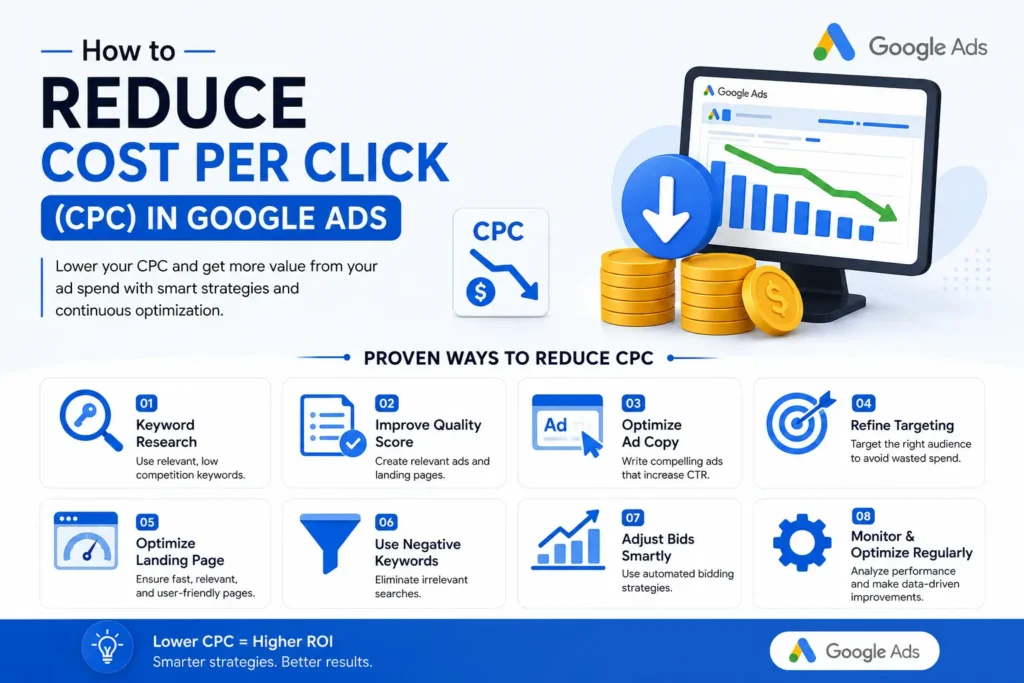
Google Ads is one of the most effective ways for businesses to reach potential customers when they are actively searching for products or services. However, advertising costs can quickly increase when campaigns are not properly optimized. One of the most important metrics advertisers monitor is Cost Per Click (CPC), which represents how much an advertiser pays, on average, when someone clicks on an ad.
A high CPC does not always mean a campaign is performing poorly. In competitive industries, expensive keywords may still generate valuable leads and sales. The real goal is to achieve a balance between lower CPC, relevant traffic, strong conversion rates, and profitable results.
Reducing CPC requires more than simply lowering bids. Advertisers need to improve keyword targeting, ad relevance, landing pages, Quality Score, bidding strategies, and overall campaign structure.
This guide explains practical ways to reduce Cost Per Click in Google Ads while maintaining campaign quality and performance.
What Is CPC in Google Ads?
Cost Per Click is the amount an advertiser pays when a user clicks on a paid advertisement. It is commonly calculated using:
CPC = Total Advertising Cost ÷ Total Number of Clicks
For example, if a campaign spends ₹5,000 and receives 500 clicks, the average CPC is ₹10.
There are two commonly discussed types of CPC:
Average CPC
Average CPC shows the average amount paid for each click across a campaign, ad group, or keyword.
Maximum CPC
Maximum CPC is the highest amount an advertiser is willing to pay for a click when using certain manual bidding approaches. Actual costs can be lower depending on the auction.
It is important to understand that Google Ads does not simply rank advertisements based on who is willing to pay the most. Several factors influence ad position and the amount an advertiser ultimately pays.
Why Is Your Google Ads CPC High?
Before trying to reduce CPC, it is important to understand why it is high in the first place.
Some common reasons include:
- Highly competitive keywords
- Broad or poorly targeted keywords
- Low ad relevance
- Weak Quality Score
- Poor landing-page experience
- Inefficient bidding strategies
- Excessive competition in the target market
- Poor geographic targeting
- Low conversion rates
- Irrelevant search queries
- Poor campaign structure
For example, a keyword such as “digital marketing agency” may be considerably more competitive than a highly specific keyword such as “digital marketing consultant for small businesses.”
Therefore, reducing CPC starts with better targeting rather than simply reducing bids.
1. Improve Your Keyword Research
Keyword selection has a major influence on Google Ads performance.
Instead of targeting only highly competitive keywords, look for keywords that have strong commercial intent but relatively manageable competition.
For example, a business selling digital marketing services could target:
- Digital marketing agency
- Digital marketing consultant
- SEO services
- Google Ads management
- PPC management services
Instead of targeting broad keywords without understanding user intent, advertisers should organize keywords according to what users actually want.
A person searching for “what is digital marketing” may only be looking for information. Someone searching for “digital marketing agency near me” may have stronger buying intent.
Understanding this difference can help advertisers allocate their budget more effectively.
2. Use Long-Tail Keywords
Long-tail keywords contain more specific search terms and can often provide better targeting.
For example:
Broad keyword:
Digital marketing
More specific keyword:
Digital marketing consultant for small businesses
The second keyword is more descriptive and can help advertisers reach users with a clearer intent.
Long-tail keywords may have lower search volume, but they can sometimes deliver more relevant clicks and better conversion opportunities.
Instead of focusing entirely on traffic volume, advertisers should focus on traffic quality.
3. Use Negative Keywords
Negative keywords are one of the most useful tools for controlling wasted advertising spend.
They prevent ads from appearing for searches that are irrelevant to the business.
For example, imagine a company provides paid digital marketing services but does not offer free courses. Search terms containing words such as “free course,” “tutorial,” or “training” might attract users who are unlikely to become customers.
Adding irrelevant terms as negative keywords can reduce wasted clicks.
Advertisers should regularly review their Search Terms Report to identify searches that triggered their ads.
This process helps answer an important question:
“Are we paying for clicks from people who are actually interested in what we sell?”
If the answer is no, negative keyword optimization should become a regular part of campaign management.
4. Improve Ad Relevance
Google wants users to see advertisements that are relevant to their searches.
Your ad copy should closely match the keywords and search intent you’re targeting.
For example, if someone searches for:
“Google Ads management services”
an ad headline such as:
“Professional Google Ads Management”
is more closely aligned with the user’s search than a generic headline such as:
“Grow Your Business Online.”
Relevant ad copy can improve engagement and help create a stronger relationship between the search query, keyword, advertisement, and landing page.
Your headlines and descriptions should clearly communicate:
- What you offer
- Who you help
- Why customers should choose you
- What action users should take
5. Improve Your Quality Score
Quality Score is an important diagnostic metric in Google Ads. It evaluates aspects of keyword and ad relevance and provides a score on a scale from 1 to 10.
Three major areas associated with Quality Score include:
- Expected click-through rate
- Ad relevance
- Landing-page experience
A stronger overall experience can help an advertiser compete more effectively in the ad auction.
To improve these areas, advertisers can:
- Make ads more relevant to keywords
- Create specific ad groups
- Improve landing pages
- Write compelling ad copy
- Remove irrelevant keywords
- Improve expected engagement
However, Quality Score should not be treated as the only measure of campaign success. Business outcomes such as conversions, revenue, and return on ad spend are ultimately more important.
6. Create More Focused Ad Groups
A poorly structured campaign can make optimization difficult.
For example, placing unrelated keywords such as “SEO services,” “social media marketing,” and “Google Ads management” into the same ad group can make it difficult to create highly relevant advertisements.
A better approach is to organize keywords around closely related themes.
For example:
Ad Group 1: Google Ads Services
- Google Ads management
- Google Ads agency
- Google Ads services
Ad Group 2: SEO Services
- SEO services
- SEO agency
- SEO consultant
This structure allows advertisers to create advertisements that closely match each keyword group.
7. Improve Your Landing Pages
Your job does not end when someone clicks the advertisement.
The landing page needs to deliver what the advertisement promised.
If an ad promotes “Google Ads management services” but sends users to a generic homepage with no clear information about Google Ads, the user experience may suffer.
A good landing page should be:
- Relevant to the advertisement
- Easy to navigate
- Mobile-friendly
- Fast-loading
- Clear and professional
- Focused on one primary goal
- Equipped with a visible call-to-action
For example, a landing page could include:
Google Ads Management Services
- Campaign setup
- Keyword research
- Ad creation
- Conversion tracking
- Campaign optimization
Then include a clear CTA such as:
Get a Free Consultation
Improving the landing-page experience can help turn more clicks into valuable actions.
8. Improve Your Click-Through Rate
Click-through rate, or CTR, measures how often people click an ad after seeing it.
A simple formula is:
CTR = Clicks ÷ Impressions × 100
For example, if an advertisement receives 100 clicks from 2,000 impressions, the CTR is 5%.
Improving CTR can indicate that your advertisement is relevant and attractive to users.
Ways to improve CTR include:
- Using relevant keywords in headlines
- Highlighting specific benefits
- Including a strong call-to-action
- Testing different headlines
- Using relevant ad assets
- Making your offer clear
Instead of simply saying:
“Digital Marketing Services”
a stronger message could communicate a benefit, such as:
“Grow Your Business With Performance Marketing”
The exact message should depend on the target audience and search intent.
9. Test Different Ad Copy
Never assume that the first version of an advertisement will be the best performer.
Google Ads allows advertisers to test different messaging within responsive search ads.
You can experiment with:
- Different headlines
- Different benefits
- Different calls-to-action
- Different offers
- Different value propositions
For example:
Headline A:
Google Ads Management Services
Headline B:
Generate More Leads With Google Ads
Headline C:
Professional PPC Campaign Management
After collecting enough data, advertisers can evaluate which messaging contributes to better engagement and conversions.
10. Optimize Geographic Targeting
If your business only serves certain locations, there is little reason to spend heavily on users outside your service area.
For example, a digital marketing consultant serving Kochi may want to prioritize relevant searches from Kerala or specific serviceable areas rather than targeting an entire country without a clear business reason.
Location targeting can help advertisers focus their budget on areas where customers are actually available.
You can analyze performance by location and adjust your campaign strategy based on:
- Clicks
- CPC
- Conversions
- Conversion rate
- Cost per conversion
This can help identify locations that generate strong business results.
11. Optimize Device Performance
People interact with Google Ads through different devices, including smartphones, tablets, and computers.
Performance can vary significantly between devices.
For example, a campaign might receive inexpensive mobile clicks but generate most conversions from desktop users.
Instead of judging performance only by CPC, analyze the complete customer journey.
Look at:
- CPC
- CTR
- Conversion rate
- Cost per conversion
- Conversion value
The cheapest click is not necessarily the most valuable click.
12. Choose the Right Bidding Strategy
Your bidding strategy should match your campaign objective.
Google Ads offers different automated and manual bidding approaches depending on the campaign type and goal.
Common approaches include strategies focused on:
- Clicks
- Conversions
- Conversion value
- Target CPA
- Target ROAS
If your main goal is generating leads or sales, optimizing only for inexpensive clicks may not be the best approach.
For example, imagine two campaigns:
Campaign A:
CPC = ₹8
Conversions = 10
Campaign B:
CPC = ₹15
Conversions = 40
Campaign B has a higher CPC, but it may be significantly more valuable to the business.
Therefore, advertisers should avoid optimizing CPC in isolation.
13. Focus on Conversion Rate
One of the biggest mistakes advertisers make is focusing entirely on reducing CPC.
Suppose your campaign receives 1,000 clicks at ₹10 per click.
Total spend = ₹10,000.
If only 5 people become customers, the campaign may not be profitable.
Now imagine another campaign receives 500 clicks at ₹15 per click.
Total spend = ₹7,500.
If 30 people become customers, the second campaign may deliver much better results despite having a higher CPC.
This demonstrates why cost per acquisition and conversion value are often more important than CPC alone.
14. Monitor the Search Terms Report
The Search Terms Report shows the actual searches that triggered your advertisements.
This report can reveal:
- Irrelevant searches
- New keyword opportunities
- High-performing search terms
- Poor-performing queries
- Search intent patterns
For example, you may discover that users are frequently searching for a specific service variation that you did not originally include as a keyword.
You can then evaluate whether that search term deserves its own keyword or ad group.
At the same time, irrelevant searches can be added as negative keywords.
This creates a continuous optimization process.
15. Improve Campaign Structure
A well-organized Google Ads account makes optimization easier.
Campaigns can be structured around:
- Product categories
- Services
- Locations
- Customer segments
- Campaign objectives
Avoid creating unnecessary complexity, but make sure each campaign has a clear purpose.
A clean structure helps advertisers understand where their money is going and which areas are producing results.
16. Avoid Chasing the Cheapest CPC
Reducing CPC should not become the only objective.
An extremely low CPC can sometimes indicate that your ads are reaching low-intent audiences.
For example:
Campaign A
CPC: ₹5
Conversion rate: 1%
Campaign B
CPC: ₹12
Conversion rate: 8%
Campaign B costs more per click, but it may generate significantly better business results.
The better question is not:
“How can I get the cheapest clicks?”
It is:
“How can I get the most valuable clicks at a sustainable cost?”
That shift in thinking is essential for successful Google Ads management.
17. Track the Right Metrics
To properly evaluate CPC optimization, monitor multiple performance metrics.
Important metrics include:
- Average CPC
- CTR
- Conversion rate
- Cost per conversion
- Conversion value
- Return on ad spend
- Impression share
- Search impression share
- Quality Score
Looking at these metrics together provides a much clearer picture of campaign performance.
For example, a rising CPC may not necessarily be a problem if conversion value is increasing faster than advertising costs.
18. Continuously Optimize Your Campaign
Google Ads should not be treated as a “set it and forget it” marketing channel.
Search behavior, competition, costs, and customer demand can change over time.
Regular optimization can include:
- Reviewing search terms
- Adding negative keywords
- Testing ad copy
- Reviewing landing pages
- Analyzing conversion data
- Checking device performance
- Reviewing geographic performance
- Adjusting budgets
- Testing bidding strategies
Even small improvements can become significant when campaigns receive thousands of clicks over time.
Conclusion
Reducing Cost Per Click in Google Ads is not simply about lowering bids. Sustainable CPC optimization comes from creating a better relationship between keywords, search intent, advertisements, landing pages, bidding strategies, and conversion goals.
Advertisers should begin with strong keyword research, use negative keywords to reduce wasted traffic, create relevant advertisements, improve landing pages, and continuously analyze campaign data.
Most importantly, do not focus on CPC alone. A campaign with a slightly higher CPC can still be highly profitable if it generates better leads, more sales, or greater conversion value.
The ultimate goal of Google Ads optimization is not to obtain the cheapest possible click. It is to obtain relevant clicks that contribute to measurable business growth at a profitable cost.
By consistently testing, analyzing, and optimizing campaigns, businesses can improve advertising efficiency while making better use of their Google Ads budget.