
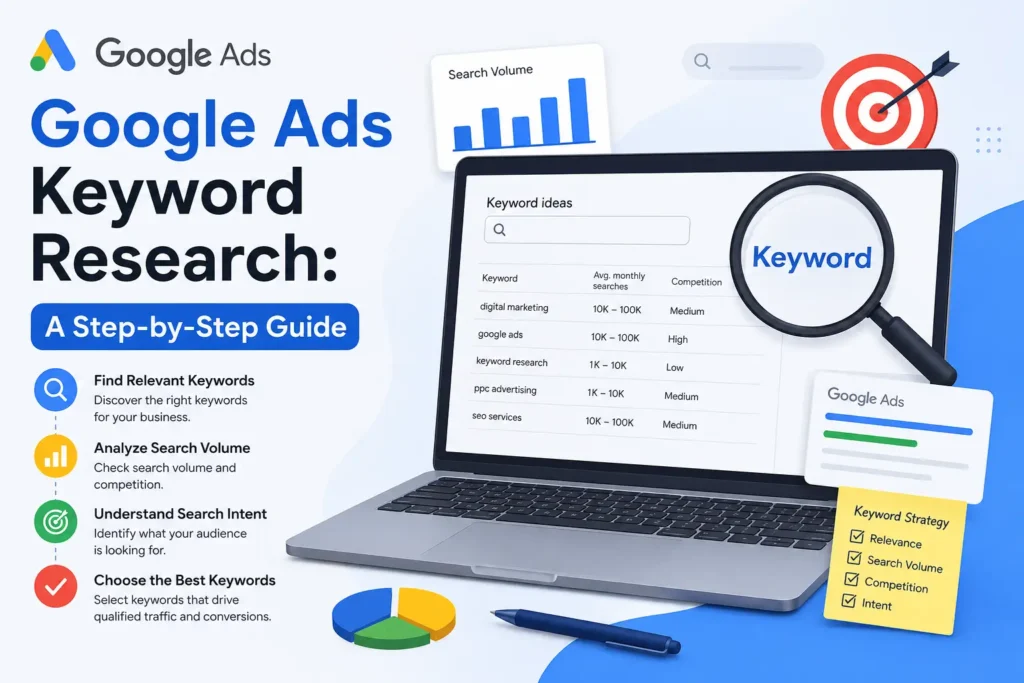
Google Ads is one of the most effective digital advertising platforms for businesses that want to reach potential customers through online search. When someone searches Google for a product, service, or solution, businesses can use Google Ads to display relevant advertisements at the right moment. However, getting good results from Google Ads is not simply about creating an advertisement and setting a budget. Choosing the right keywords is one of the most important parts of building a successful Search campaign.
Google Ads keyword research helps advertisers understand what potential customers are searching for and which search terms are most relevant to their business. When keyword research is done correctly, it can help improve ad relevance, attract more qualified visitors, control advertising costs, and increase conversions.
This guide explains Google Ads keyword research step by step and provides a practical approach that beginners and experienced advertisers can use to build better campaigns.
What Is Google Ads Keyword Research?
Google Ads keyword research is the process of finding, analyzing, and selecting search terms that potential customers may use on Google.
For example, imagine a business that sells running shoes. Potential customers might search for:
- Buy running shoes online
- Best running shoes
- Running shoes for men
- Running shoes for women
- Affordable running shoes
- Sports shoes online
- Running shoes near me
These search terms can become potential keywords for a Google Ads campaign.
However, not every keyword related to running shoes should automatically be targeted. Advertisers need to consider search intent, relevance, competition, cost, and the likelihood that a search will lead to a valuable action.
The purpose of keyword research is therefore not simply to find as many keywords as possible. The real goal is to find the right keywords for the right audience and the right campaign objective.
Why Is Keyword Research Important for Google Ads?
Keyword research has a direct impact on how effectively a Search campaign reaches potential customers.
1. Helps Reach Relevant Customers
The right keywords allow advertisements to appear when people search for terms related to your products or services.
For example, an online laptop store would benefit more from targeting searches such as “buy laptop online” than unrelated searches such as “how laptops work.”
Better relevance can help attract visitors who are more likely to become customers.
2. Helps Control Advertising Costs
Google Ads operates through an advertising auction. Different keywords can have different levels of competition and costs.
If you target highly competitive keywords without a clear strategy, your campaign may consume a large portion of your budget.
Keyword research allows advertisers to identify opportunities that balance search demand, competition, relevance, and potential business value.
3. Improves Conversion Opportunities
People search Google with different intentions.
Someone searching for “what are running shoes” may simply be researching.
Someone searching for “buy running shoes online” is likely closer to making a purchase.
Understanding these differences helps advertisers prioritize keywords that are more likely to produce conversions.
4. Creates Better Campaign Structure
Keyword research also helps organize campaigns into logical ad groups.
When related keywords are grouped together, advertisers can create more relevant advertisements and landing pages.
This makes campaigns easier to manage and optimize.
Step 1: Understand Your Business
Before starting keyword research, you need to understand what your business actually offers.
Write down:
- Products or services
- Main benefits
- Target customers
- Locations served
- Customer problems
- Main competitors
- Unique selling points
For example, a business selling fitness equipment may offer:
- Treadmills
- Exercise bikes
- Dumbbells
- Yoga equipment
- Home gym accessories
Instead of immediately searching for hundreds of keywords, start by understanding the categories of products or services you want to advertise.
This creates a strong foundation for the research process.
Step 2: Identify Your Target Audience
Your keywords should reflect the language your potential customers use.
Think about your ideal customer.
Ask questions such as:
- Who is looking for this product?
- What problem are they trying to solve?
- What words would they type into Google?
- Are they looking for information or ready to buy?
- Where are they located?
- What price range are they interested in?
For example, a person looking for a wedding photographer may search for:
- Wedding photographer
- Wedding photographer near me
- Wedding photography packages
- Affordable wedding photographer
- Wedding photographer prices
Understanding the audience makes it easier to predict useful search terms.
Step 3: Create Seed Keywords
Seed keywords are basic terms that describe your business.
Suppose you run a digital marketing service. Your seed keywords could include:
- Digital marketing
- SEO services
- Google Ads
- Social media marketing
- PPC advertising
- Content marketing
These keywords are not necessarily the final keywords you will use.
They are starting points for discovering more specific search terms.
You can create seed keywords from:
- Product categories
- Service names
- Website pages
- Customer questions
- Industry terminology
- Competitor offerings
- Common problems your customers face
Step 4: Use Google Keyword Planner
Google Keyword Planner is a useful tool for discovering keyword ideas and planning Search campaigns.
You can enter a seed keyword and explore related suggestions.
For example, entering a keyword such as “digital marketing services” may help you discover related terms involving agencies, consultants, SEO, PPC, social media marketing, and other services.
When reviewing keyword suggestions, don’t focus only on search volume.
Look at the bigger picture:
- Is the keyword relevant?
- Does it match the campaign goal?
- What is the search intent?
- Is there commercial potential?
- How competitive is it?
- Can the business realistically convert this traffic?
Keyword tools are useful for generating ideas, but human judgment is still important.
Step 5: Understand Search Intent
Search intent refers to the reason behind a user’s search.
Understanding intent is one of the most important parts of keyword research.
Informational Intent
The user wants to learn something.
Examples:
- What is Google Ads?
- How does PPC work?
- How to create a Google Ads campaign
- What is keyword research?
These searches are mainly educational.
Commercial Investigation
The user is researching products or services before making a decision.
Examples:
- Best Google Ads agency
- Best running shoes
- SEO agency reviews
- Laptop comparison
These searches can have stronger commercial value.
Transactional Intent
The user is ready to take action.
Examples:
- Buy running shoes online
- Hire Google Ads expert
- Order laptop online
- Book digital marketing consultation
Transactional keywords are often particularly valuable for sales and lead-generation campaigns.
Navigational Intent
The user is looking for a specific website, brand, or destination.
Examples:
- Google Ads login
- Amazon login
- YouTube
These keywords may not be appropriate for many advertising campaigns because the user already has a specific destination in mind.
Step 6: Analyze Keyword Relevance
Relevance should be one of your first filters.
Ask yourself:
“If someone searches this keyword, would they genuinely be interested in my product or service?”
For example, a company selling professional photography services may consider:
Wedding photographer near me
Highly relevant.
But:
Photography course
May not be relevant if the company only provides photography services and does not sell courses.
Even though both keywords contain the word “photography,” they represent completely different user needs.
Targeting irrelevant keywords can result in wasted clicks and advertising budget.
Step 7: Analyze Search Volume
Search volume indicates how frequently people search for a particular keyword.
High-volume keywords can potentially generate large amounts of traffic.
However, high search volume does not automatically mean high performance.
For example:
“Shoes”
could have enormous search demand, but it is extremely broad.
Meanwhile:
“Buy men’s running shoes online”
may have lower search volume but stronger purchasing intent.
Therefore, keyword research should focus on quality rather than quantity.
A lower-volume keyword with strong commercial intent can sometimes be more valuable than a high-volume keyword with unclear intent.
Step 8: Understand Keyword Competition
Competition is another important factor.
Highly competitive keywords may attract many advertisers, which can increase advertising costs.
For example, keywords related to industries such as:
- Insurance
- Legal services
- Finance
- Real estate
- Software
- Education
can be highly competitive in many markets.
However, competition should not automatically make you avoid a keyword.
Instead, evaluate whether the keyword can generate enough business value to justify the cost.
A profitable keyword can still be worthwhile even when its CPC is relatively high.
Step 9: Understand Keyword Match Types
Google Ads provides different keyword match types that influence how closely a search needs to relate to your selected keyword.
Broad Match
Broad match provides wider reach and allows Google to match ads with searches related to the meaning of the keyword.
It can provide additional reach and keyword discovery opportunities, particularly when campaigns have strong conversion tracking and appropriate automated bidding.
However, advertisers should monitor search-term performance carefully.
Phrase Match
Phrase match provides more control while still allowing relevant variations and searches that contain the meaning of the keyword.
It can provide a balance between reach and control.
Exact Match
Exact match gives advertisers greater control over the searches that can trigger their ads, although Google can still match relevant close variants and searches with the same intent.
The best match type depends on your campaign structure, conversion data, bidding strategy, and objectives.
Step 10: Find Negative Keywords
Keyword research is not only about discovering keywords you want.
You should also identify searches you do not want.
These are negative keywords.
For example, a company offering paid Google Ads management might not want clicks from people searching for:
- Google Ads free course
- Google Ads tutorial
- Google Ads jobs
- Google Ads internship
- Google Ads certification
These searches may be related to Google Ads but may not represent potential customers.
Adding appropriate negative keywords can reduce irrelevant traffic and help protect your advertising budget.
Negative keyword research should continue after the campaign launches because actual search-term data can reveal new irrelevant searches.
Step 11: Research Long-Tail Keywords
Long-tail keywords are longer and more specific search phrases.
Examples include:
- Google Ads consultant for small businesses
- Affordable running shoes for women
- Best laptop for graphic designers
- Digital marketing services for restaurants
Long-tail keywords often have lower search volume than broad keywords.
However, they can provide valuable information about the user’s needs.
Compare:
“Laptop”
with:
“Best laptop for video editing under ₹80,000”
The second search provides much more information about the user’s intent.
Specific searches can therefore be valuable for businesses targeting niche audiences.
Step 12: Analyze Local Keywords
If your business serves a specific geographic area, local keyword research can be very useful.
Examples include:
- SEO agency in Kochi
- Dentist near me
- Digital marketing services in Kerala
- Restaurant near me
- Car service center in Ernakulam
Location-based searches can help businesses reach people who are looking for services in a particular area.
However, advertisers should combine keyword targeting with appropriate location settings inside Google Ads to make sure campaigns reach the intended geographic audience.
Step 13: Analyze Competitors
Competitor research can provide useful insights into the market.
Look at competitors and analyze:
- Their main services
- Their advertisements
- Their offers
- Their landing pages
- Their messaging
- Their positioning
- Their calls to action
The goal is not to copy their keywords or advertisements.
Instead, competitor research helps you understand:
What does the market already offer, and how can your business provide something different?
For example, if competitors focus on low prices, another business could differentiate itself through quality, customer service, speed, specialization, or measurable results.
Step 14: Group Keywords Into Ad Groups
Once your keyword research is complete, organize related keywords into logical groups.
For example:
Ad Group: Google Ads Services
- Google Ads services
- Google Ads management
- Google advertising services
- PPC management services
Ad Group: SEO Services
- SEO services
- SEO agency
- SEO consultant
- SEO company
Ad Group: Social Media Marketing
- Social media marketing services
- Social media agency
- social media management
- social media marketing company
Grouping similar keywords makes it easier to create relevant advertisements.
It also helps advertisers connect keywords with appropriate landing pages.
Step 15: Create Relevant Ad Copy
Your keyword strategy should influence your ad copy.
Suppose you are targeting:
Google Ads Management Services
Your advertisement could communicate:
Google Ads Management Services
Increase Qualified Traffic
Improve Campaign Performance
Get in Touch Today
The advertisement should clearly communicate what the customer can expect.
Avoid misleading claims or promises that the landing page cannot support.
The keyword, advertisement, and landing page should all work together.
Step 16: Build Relevant Landing Pages
A user who clicks your advertisement should reach a page that directly matches their search.
For example, if someone searches for:
SEO services
they should ideally land on a page that clearly explains your SEO services.
A relevant landing page should generally include:
- Clear headline
- Description of the service
- Benefits
- Pricing information where appropriate
- Trust signals
- Testimonials where available
- Relevant images
- Clear call to action
- Contact information
A strong landing page can make the traffic generated by keyword research more valuable.
Step 17: Monitor Search Terms After Launch
Keyword research does not end when the campaign goes live.
After your ads begin receiving traffic, analyze the actual search terms that triggered your advertisements.
This can help you identify:
- New keyword opportunities
- Irrelevant searches
- Negative keywords
- Customer language
- Unexpected search intent
- Potential new ad groups
This process allows your campaign to become more refined over time.
Step 18: Measure Keyword Performance
After launching your campaign, monitor important performance metrics.
Impressions
The number of times your advertisement was shown.
Clicks
The number of times users clicked your advertisement.
CTR
Click-through rate measures how frequently people click your advertisement after seeing it.
CPC
Cost per click shows how much you are paying for clicks.
Conversions
Conversions measure valuable actions such as purchases, leads, calls, or form submissions.
Conversion Rate
This shows the percentage of relevant interactions that resulted in a conversion.
Cost Per Conversion
This helps you understand how much you are spending to generate a conversion.
Looking at these metrics together provides a better understanding of keyword performance.
Common Google Ads Keyword Research Mistakes
Choosing Keywords Only Based on Search Volume
A keyword with high search volume may attract many visitors but few customers.
Ignoring Search Intent
The same word can represent different customer needs.
Targeting Too Many Keywords
More keywords do not necessarily mean better results.
Forgetting Negative Keywords
Irrelevant searches can consume your budget.
Using Only Broad Keywords
Very broad keywords can attract users with different intentions.
Ignoring Long-Tail Keywords
Specific searches can provide valuable opportunities.
Not Reviewing Search Terms
Actual search-term data can reveal information that keyword tools cannot predict perfectly.
Sending All Traffic to One Landing Page
Different services and search intents may require different landing pages.
Google Ads Keyword Research Best Practices
To create a strong keyword strategy, follow these principles:
- Start with your business objectives.
- Understand your target audience.
- Build a list of seed keywords.
- Expand the list using keyword research tools.
- Analyze search intent.
- Prioritize relevance.
- Consider search volume and competition.
- Use appropriate match types.
- Build a negative keyword list.
- Include relevant long-tail keywords.
- Use location-based targeting when appropriate.
- Organize keywords into logical ad groups.
- Create relevant advertisements.
- Build matching landing pages.
- Track conversions accurately.
- Review search-term data regularly.
- Remove or adjust poor-performing keywords.
- Continuously test and optimize your campaigns.
Final Thoughts
Google Ads keyword research is the foundation of an effective Search advertising strategy. It allows advertisers to understand what potential customers are searching for and helps connect those searches with relevant advertisements and landing pages.
The most important principle is to focus on relevance and intent rather than simply chasing high search volume.
A successful keyword strategy combines several elements: understanding the target audience, finding relevant search terms, analyzing intent, evaluating competition, selecting appropriate match types, using negative keywords, researching long-tail opportunities, and continuously monitoring campaign data.
Keyword research is also an ongoing process. Customer behavior changes, competitors introduce new offers, and search trends evolve. Regular analysis allows advertisers to discover new opportunities and eliminate traffic that does not contribute to business goals.
When keyword research, ad copy, landing pages, conversion tracking, and campaign optimization work together, Google Ads can become a powerful channel for generating qualified traffic, leads, and sales.
Whether you are starting your first Search campaign or improving an existing one, taking the time to research and organize your keywords properly can help you make better advertising decisions and use your budget more efficiently.